

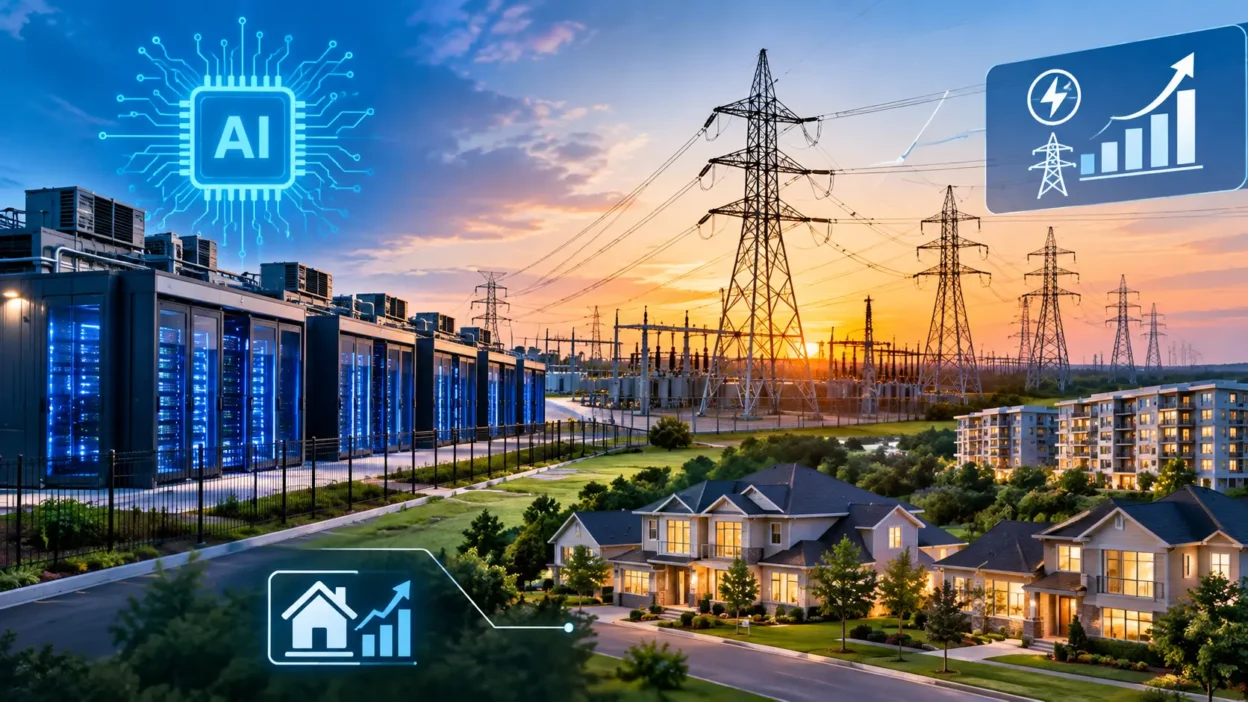
| Quick Answer AI data centers use huge amounts of electricity — sometimes as much as a small city — which is putting real strain on local power grids and pushing up electricity bills in some areas. Their effect on nearby home values is mixed: some studies show prices holding steady or even rising near good infrastructure, while noise, construction, and rising utility costs can put off certain buyers. There is no single answer; it depends on your specific town, utility, and street. |
You have probably heard the term “AI data centre”, and that it has been on the news a lot recently. Maybe it was with an article about the electricity prices, or a story about a building being built in the outskirts of the city. It doesn’t seem like a big thing to wonder about, maybe you have even wondered about it yourself. These buildings are being built at an increasing rate, and it’s having a huge impact on the electricity grid. Not only that, but it can even influence the value of your house! Let’s dive into it and explore it together.
Why AI Data Centres Use So Much Electricity
An AI data center is not your average server room at the local council office. Inside these sprawling facilities — many of which are the size of football fields — rows upon rows of computers’ cores work simultaneously to train and operate AI systems, from chatbots to image-generating behemoths.
The electricity needed to perform a single task can be up to 1,000 times greater than a typical Google search due to the intense computations required for such operations. That means a single large-scale facility can consume 3.9 terawatt-hours (TWh) of electricity per year — equivalent to powering 360,000 U.S. homes.
Now experts are trying to gauge just how big of an impact this industry will have on electricity consumption in the United States once hundreds of data centers are built or are in development nationwide.
How This Demand Is Straining the Power Grid
The United States electricity grid was largely constructed decades ago and has since evolved at a slow pace, while data centers consume an unprecedented amount of electricity on a continuous basis. According to the Lawrence Berkeley National Laboratory, data center electricity consumption is projected to increase from around 176 terawatt-hours in 2023 to 325 to 580 terawatt-hours by 2028. This means that there will be an incredible strain on the existing grid infrastructure that grew steadily for the past two decades. The situation is especially acute in the regions already hosting a large number of data centers, such as Virginia, where power producers are scrambling to meet rising demand, creating challenges for electricity distribution and grid stability and forcing difficult questions about who should bear the costs of the needed upgrades to the grid. Some data center developers are beginning to construct their own power plants to supplement grid electricity, using natural gas, solar energy, or batteries for storage because the process of upgrading the grid takes too long.
Are Your Electricity Bills Going Up Because of Data Centres?
This is the question most homeowners are asking, the answer to which, as you might guess, depends on where you live. According to the National Association of REALTORS®, the residential electricity rates in the United States increased by 21.4% on average between 2020 and 2024 in counties which housed ten or more data centers, compared to 15.7% in counties without them.
Electricity tariffs are impacted by numerous factors including fuel prices, aging infrastructure, and demand within the region which are unrelated to data centers, say experts. Nevertheless, in some states, this issue has taken on political dimensions. The state of Florida recently enacted legislation to prevent home owners from being unfairly charged for the costs of upgrading the electrical grid to meet the demands of AI companies. Meanwhile, consumer advocates in Ohio are pushing for similar measures to be taken.
What Happens to Home Values Near a Data Centre?
Here’s where it gets surprising. According to a George Mason University study in Virginia, home values tend to go up, rather than down, near data centers. But the study’s authors note that this is due to data centers being built in the same places as desirable infrastructure such as roadways and fiber optics. It isn’t that the data center itself is driving up prices, but that both are attractive to buyers.
Nationally, the jury’s still out on whether data centers raise or lower home values, say REALTORS (r) who responded to a National Association of REALTORS (r) survey in 2026. Of the respondents, 26% said they believed home values were negatively affected by data centers in the area; 27% said there was no effect; and 19% said they believed home values were positively affected. In growing cities such as Abilene, Texas – where the large Stargate data center project is being built – agents say demand is high and rents are rising as people move in for the jobs that the data centers provide. But in some areas of Texas and Utah, citizens are taking action to stop new developments, complaining of noise and land use.
The Other Side: Noise, Water and Everyday Quality of Life
Apart from the increased rates of electricity and property prices, people living near data centers also consider things like the noise from fans, extra traffic from reinforced concrete buildings, and the amount of water used for cooling. While none of these issues are significant on their own, the combination might affect the property’s desirability, thus influencing its sale price and speed.
What Homeowners and Buyers Can Do
If you’re buying, selling, or already living near a proposed data centre site, a few simple steps help:
- Ask your local council or planning office what’s actually approved nearby, not just rumoured
- Check your utility’s public filings for any planned rate changes tied to large new customers
- Talk to a local estate agent who knows how nearby developments have actually affected sales, not just national headlines
- Attend local planning meetings if a data centre is proposed near you — this is where decisions about noise limits, tax breaks, and cost-sharing actually get made
Frequently Asked Questions
Do AI data centres really use as much electricity as a whole city?
Some of the largest facilities do. A single large AI data centre can use as much electricity annually as hundreds of thousands of homes, depending on its size and how much it’s used.
Will data centres make my electricity bill go up?
Possibly, though the effect varies by state and utility. Counties with many data centres have seen slightly faster electricity rate increases than areas without them, but many other factors affect your bill too.
Do data centres lower nearby home values?
Not consistently. Some studies show home prices near data centres holding steady or even rising, largely because they’re built in areas with strong existing infrastructure that buyers already want.
Why are data centres being built so close to homes now?
Developers need fast access to power, fibre internet, land, and highways, and many of the best-connected sites happen to be near existing residential areas.
Can local residents stop a data centre being built nearby?
Sometimes, through planning objections and public meetings, though it depends heavily on local zoning rules and how far along the project already is.